




Researchers at IMDEA Nanociencia develop a method to determine the temperature of magnetic nanoparticles
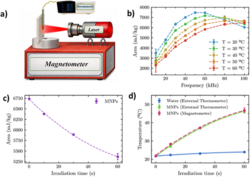
Demonstration of combined heat generation and sequential magnetic temperature readout using MNPs.
- Researchers at IMDEA Nanociencia and the Autonomous University of Madrid have developed an approach that obtains temperature information from variations in the dynamic magnetization of nanoparticles.
- The results demonstrate the potential of cobalt ferrite nanoparticles as a label-free platform that combines heat generation with temperature determination in a magnetic suspension. This advance opens new possibilities for real-time thermal monitoring.
| Tweet |  |
Press release download |
Madrid, 23 rd september, 2026. Nanoparticles are structures thousands of times smaller than the width of a human hair. Some magnetic nanoparticles can convert externally supplied energy into heat, giving them considerable potential for targeted thermal treatments, including those used against solid tumors. However, accurately determining the temperature reached in tissues during heating remains a challenge. Methods are therefore needed that can provide thermal information in a straightforward manner without interfering with either the temperature measurement or the heating process itself.
A research team from IMDEA Nanociencia and the Autonomous University of Madrid (UAM) has developed a method for extracting information about the temperature of the surrounding environment from the magnetic response of nanoparticles. Moreover, temperature can be determined without incorporating additional fluorescent labels or fluorophores, making this a label-free approach.
The study used magnetic nanocrystals composed of cobalt ferrite, a material containing iron and cobalt as its magnetic elements. When irradiated with near-infrared (NIR) light, the nanoparticles released heat, confirming their ability to act as nanoheaters. In parallel, dynamic magnetization measurements were performed by applying alternating magnetic fields at frequencies ranging from 10 to 100 kHz and at temperatures between 20 and 50 °C. The results revealed a close relationship between temperature and the area of the magnetization loops. These measurements made it possible to determine the temperature of the magnetic suspension while it was being irradiated with light. The numerical model used in the study supported the experimental results and confirmed the potential of this method to determine the temperature of a nanoparticle suspension in real time. Looking ahead, imaging techniques such as magnetic particle imaging (MPI), which are also based on dynamic magnetization measurements within this frequency range, could be used to produce spatially resolved temperature maps in animal models. This would require correlating local magnetic responses with temperature-dependent relaxation processes. Such an approach could facilitate the application of magnetic thermometry to cancer treatments based on magnetic nanoparticle-mediated hyperthermia.
The study, led by Sebastian A. Thompson and Francisco J. Terán, combines an investigation of nanoparticle magnetic dynamics with models that relate their response to the thermal properties of the surrounding medium. The results are particularly relevant to localized heating and thermal-monitoring strategies, in which knowing the temperature reached is essential for controlling the process.
The findings have been published in Small, a journal specializing in nanotechnology and materials science. The study establishes an experimental platform that combines heat generation with the acquisition of temperature information. According to the authors, this approach opens the way to future thermal-monitoring applications in nanoscale heating systems, including treatments based on heat.
Glossary:
- Magnetic nanoparticle: a nanoparticle with nanoscale dimensions that exhibits magnetic properties and whose response can be modified by external magnetic fields.
- Magnetic Nanheater: a nanoparticle or nanomaterial capable of converting externally supplied energy into heat at the nanoscale.
- Dynamic magnetization: the magnetic response of a material when subjected to a magnetic field that changes over time. In this work, variations in this response are used to obtain information about temperature.
Reference:
A. Venegas-Gomez, P. Palacios-Alonso, C. S. Carrizo, et al. “ Magnetic Nanoparticles as Label-Free Dual-Function Nanoheaters and Nanothermometers.” Small 22, no. 37 (2026): e73780. https://doi.org/10.1002/smll.73780
 https://hdl.handle.net/20.500.12614/4282
Contact:
Sebastian A. Thompson (This email address is being protected from spambots. You need JavaScript enabled to view it.)
https://www.nanociencia.imdea.org/intracellular-temperature-measurements/home
Francisco J. Terán (This email address is being protected from spambots. You need JavaScript enabled to view it.)
IMDEA Nanociencia Dissemination and Communication Office / Oficina de Comunicación y Divulgación de IMDEA Nanociencia


Source: IMDEA Nanociencia.
IMDEA Nanociencia Institute is a young interdisciplinary research Centre in Madrid (Spain) dedicated to the exploration of nanoscience and the development of applications of nanotechnology in connection with innovative industries.