




Defects that help, not hurt: curved nanographenes keep their conductance while gaining processability
22.01.2026
 |
|
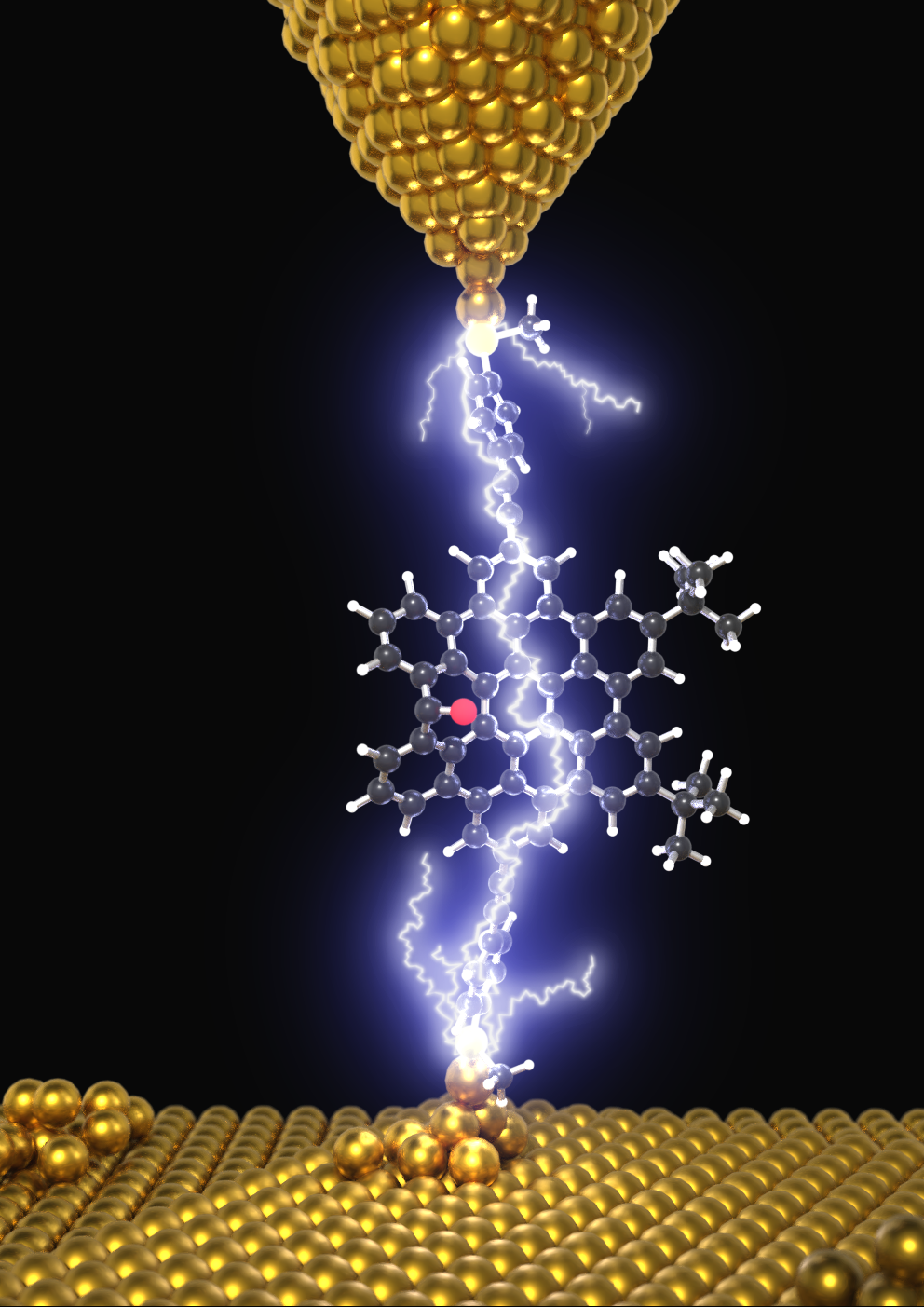
A saddle shaped nanographene between two gold electrodes. Credit: Patricia Bondía. |
- Researchers at IMDEA Nanociencia find a family of saddle-shaped nanographenes that conduct electricity as efficiently as flat ones.
- The study reveals that molecular curvature on nanographenes can boost their solubility without harming their electrical performance.
| Tweet |  |
Press release download |
Madrid, 22th January, 2026. Understanding how electricity flows through a single molecule is essential for building the next generation of ultra-small electronic devices. At this scale, even the smallest change in a molecule’s structure can affect its electrical behavior. Graphene—an atom-thin form of carbon known for its remarkable conductivity—is a promising material in this field. Scientists are now using nanographenes, tiny graphene fragments that act as precise molecular models, to investigate how particular defects influence the electrical conductance.
In a new study published in Nanoscale (Royal Society of Chemistry), researchers have investigated how curvature affects the electrical conductance of nanographenes. The work focuses on molecules that are not flat, but instead curved —like horse saddle or a Pringle potato chip— due to specific structural defects. These curved nanographenes were carefully designed and synthesized, and their conductance was measured both as single molecules and as organized monolayers. The study included experimental and theoretical perspectives. While defects in graphene are usually expected to disrupt electrical transport, the team discovered that the negative curvature produced in a particular way (inclusion of a heptagonal ring within the honeycomb lattice) does not significantly change how electrons flow through the molecule.
This finding is highly relevant because it shows that molecular curvature can improve practical properties—such as solubility in solution—without sacrificing electrical performance. In these nanographenes, the effect of the curvature and the chemical modifications, needed for inducing it, compensate each other, resulting in conductance values comparable to flat molecules. Importantly, this work represents the first experimental attempt to directly measure the effect of curvature on electron transport in curved nanographenes. “We were surprised to see that it is possible to add curvature without hindering the electrical conductance of these nanographenes,” says Lucia Palomino, first author of the study.
The study is the result of the PhD thesis work of Lucia Palomino Ruiz, which was carried out between Universidad de Granada and IMDEA Nanociencia institute, under the supervision of Araceli G. Campaña, Alba Millán, and M. Teresa González. It is a collaborative effort involving scientists from the Madrid Institute for Advanced Studies in Nanoscience (IMDEA Nanociencia), Universidad de Granada, Institut de Ciència de Materials de Barcelona (ICMAB-CSIC), and Universidad Autónoma de Madrid and is partially funded by the accreditation Excellence Severo Ochoa awarded to IMDEA Nanociencia (CEX2020-001039-S).
Glossary:
- Nanographene: a nanostructure or piece made from graphene —a sheet of hexagonal interlocked carbon atoms— with typically less than 100 nm size.
- Negative curvature: a surface that curves away from a tangent plane in opposite directions. A saddle horse is an example of a negatively curved object.
- Conductance: a measure of the ease with which an electrical current flows in a certain path or material
Reference
 Link to IMDEA Nanociencia Repository: https://hdl.handle.net/20.500.12614/4156
Contact:
M. Teresa González
Neural Interfaces Group
https://nanociencia.imdea.org/neural-interfaces/home
IMDEA Nanociencia Dissemination and Communication Office
divulgacion.nanociencia [at]imdea.org


Source: IMDEA Nanociencia.
IMDEA Nanociencia Institute is a young interdisciplinary research Centre in Madrid (Spain) dedicated to the exploration of nanoscience and the development of applications of nanotechnology in connection with innovative industries.